For investors, airport authorities, and EPC contractors, the key question is:
What truly drives the cost of a large-span aircraft hangar?
Understanding these cost drivers is the first step toward making informed investment decisions and optimizing lifecycle costs.
Structural System Selection: The Starting Point of Cost Control
The choice of structural system directly impacts steel consumption and foundation costs. Currently, space frame structures, truss systems, and portal frames are the most commonly used solutions.
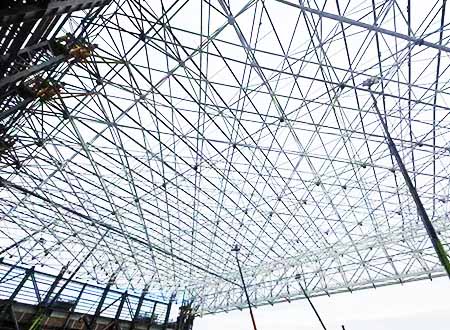
Among them, welded ball space frames and bolted ball space frames are widely adopted for ultra-large-span hangars exceeding 200 meters, thanks to their efficient load distribution, high stiffness, and excellent seismic performance.
Through advanced finite element analysis (FEA) and BIM-integrated design, engineers can optimize member sections and joint configurations while meeting wind, snow, and seismic load requirements.
This approach can reduce steel consumption by 15%–25%, significantly lowering the cost of the primary structure.
High-Strength Steel & Advanced Materials: A Key Path to Cost Reduction
Material costs typically account for over 40% of the total structural cost of a hangar. In recent years, the extensive use of high-strength steel (such as Q390, Q420, and Q460) has become a major breakthrough.
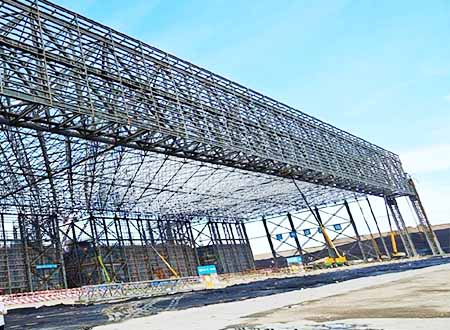
Compared to conventional grades like Q235 or Q345, high-strength steel can reduce the self-weight of roof structures by 25%–30%, which in turn decreases the demand for reinforced concrete columns, isolated foundations, and pile foundations.
In addition, the use of weathering steel in secondary structures can significantly reduce long-term anti-corrosion maintenance costs.
Emerging technologies such as prestressed steel structures and carbon fiber reinforced polymers (CFRP) are also being explored, offering further potential for lightweight and high-performance design in the future.
Advanced Construction Methods: Time Is Cost
Construction methodology plays a critical role in overall project cost. Traditional high-altitude assembly methods are not only time-consuming but also involve higher safety risks.
Today, the industry increasingly adopts the “ground assembly + hydraulic lifting” method. In this approach, massive steel roof structures—often weighing thousands of tons—are fully assembled at ground level. Systems such as siphonic drainage, fire protection pipelines, and cable trays can also be installed simultaneously.
The entire structure is then lifted into position using computer-controlled hydraulic systems.
In practice, this method can reduce construction time by more than 40%, while also lowering costs associated with large lifting equipment and high-altitude safety measures.
For example, in some of the largest hangar projects in Asia, the full lifting process was completed in just 2–3 days, demonstrating remarkable economic efficiency.
Choosing a Reliable Prefabricated Steel Structure Manufacturer
Beyond design and construction techniques, the execution capability of your partner is equally critical to cost control.
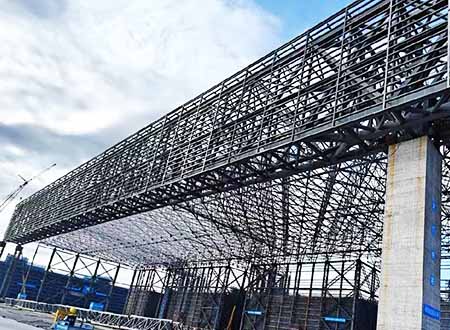
Henan Gefan Building Materials Co., Ltd. is a professional manufacturer specializing in prefabricated steel structures. The company focuses on delivering solutions for overseas projects, including warehouses, coal storage sheds, industrial buildings, and large-span structures.
With strong execution capabilities and consistent product quality, the company helps clients effectively control manufacturing, transportation, and delivery costs while meeting international standards—making it a reliable partner for large-span aircraft hangar projects.
Conclusion: Look Beyond Unit Price—Focus on Lifecycle Cost
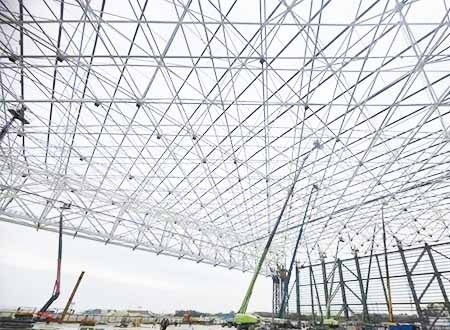
Investing in a large-span aircraft hangar is not simply about comparing the cost per ton of steel or price per square meter.
Instead, a comprehensive evaluation should consider:
- Structural optimization
- Application of high-strength materials
- Advanced construction methods
- The experience and reliability of the manufacturing partner
Only by adopting a Lifecycle Cost (LCC) approach from the design stage can investors achieve the optimal balance of safety, efficiency, and cost-effectiveness—ensuring long-term, stable returns on investment.